
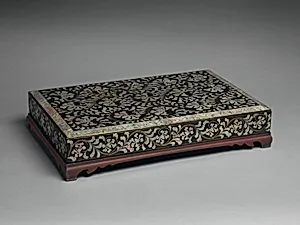
나전 칠 모란 넝쿨 무늬 서류상자 조선|螺鈿漆牡丹唐草文書類箱子 朝鮮|Stationery box decorated with peony scrolls
Unknown Artist
18th century
Medium
Lacquer inlaid with mother-of-pearl
Dimensions
H. 5 3/8 in. (13.7 cm); W. 15 in. (38.1 cm); L. 22 3/8 in. (56.8 cm)
Classification
Lacquer
Culture & Period
Korea · Joseon dynasty (1392–1910)
Department
Asian Art
Museum
Metropolitan Museum of Art, New York, NY
Credit
Gift of Florence and Herbert Irving, 2015
Accession Number
2015.500.3.5a, b
Rights
Public Domain
Tags
Art Historical Context
This exquisite stationery box from 18th Joseon Korea (139–1910) showcases the pinnacle of Korean lacquer craftsmanship.ed as a practical yet luxurious container for documents, brushes, inkstones—essentials Confucian scholars—it measures a compact H. 5⅜ in. (13. cm) by W.15 in. (38. cm) by L. 22⅜ in. (.8 cm), making it ideal for a scholar's desk travel. The box is adorned intricate peony scroll motifs rendered in the renowned *najeon* technique: thin mother-of-pearl shells meticulously cut, polished, and inlaid into black lacquer layers, then sealed with additional lacquer for a luminous, iridescent glow. Peonies, symbols of prosperity and nobility in East Asian culture, vine gracefully across the surfaces, their blooming forms evoking abundance and elegance amid Joseon's refined scholarly aesthetic. As a gift to the Metropolitan Museum of Art from Florence and Herbert Irving in 2015, this anonymous masterpiece highlights Joseon artisans' mastery of durable, opulent materials. Lacquerware like this was reserved for the elite, blending utility with artistry in a society that prized moral cultivation and aesthetic harmony. Visitors will appreciate its subtle sheen, a testament to enduring Korean ingenuity.