
Dish with 'Kaleidoscope' Design
Unknown Artist
ca. 1580–85
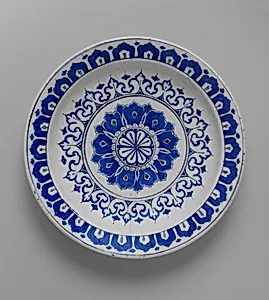
Medium
Stonepaste; polychrome painted under transparent glaze
Dimensions
H. 2 11/16 in. (6.8 cm) Diam. of rim: 13 3/4 in. (34.9 cm)
Classification
Ceramics
Department
Islamic Art
Museum
Metropolitan Museum of Art, New York, NY
Credit
Gift of Philippe and Edith de Montebello, 1991
Accession Number
1991.172
Rights
Public Domain
Art Historical Context
This exquisite *Dish with 'Kaleidoscope' Design*, crafted around 1580–85 by an unknown artist, exemplifies the pinnacle of Islamic ceramic artistry. Made from stonepaste—a finely ground mixture of quartz, clay, and glass frit that mimicked the prized Chinese porcelain—this shallow dish measures just 2⅝ inches high but boasts an impressive 13¾-inch rim diameter, perfect for serving communal meals or displaying as a decorative charger. The polychrome pigments, painted beneath a transparent glaze, were fired at high temperatures, ensuring vibrant colors that endure centuries. The 'kaleidoscope' moniker evokes the dish's likely swirling, radial motifs, a hallmark of late 16th-century Islamic decorative traditions in the Ottoman Empire or Safavid Iran, where such wares adorned palaces and homes. Stonepaste technology, perfected in the Islamic world from the 10th century onward, allowed for intricate details and a luminous surface unachievable in local clays, bridging Eastern and Western aesthetics through trade routes. Today, this gift to the Metropolitan Museum of Art from Philippe and Edith de Montebello in 1991 invites us to marvel at the anonymous genius behind Islamic ceramics—functional beauty that transformed everyday objects into symphonies of color and symmetry.