
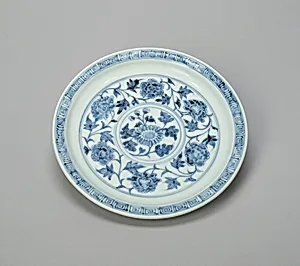
Dish with Peony Scrolls and Chrysanthemum Spray, and Lotus Panels on Reverse
Ming dynasty (1368–1644), Hongwu period (1368–98)
Medium
Porcelain painted in underglaze blue
Dimensions
2.4 × 19.6 cm (15/16 × 7 3/4 in.); Diam.: 19.6 cm (7 3/4 in.)
Classification
dish (vessel)
Department
Arts of Asia
Museum
Art Institute of Chicago
Accession Number
80912
Rights
Public Domain
Art Historical Context
This elegant porcelain dish, created during the Hongwu period (1368–98) at the dawn of the Ming dynasty, exemplifies the refined artistry of early imperial Chinese ceramics. Produced in the renowned kilns of Jingdezhen, it reflects a time when porcelain production reached new heights of technical mastery under imperial patronage. The piece’s compact form and delicate proportions highlight the era’s emphasis on harmony between utility and beauty, serving both as a functional vessel and a work of art. The dish features intricate underglaze blue decoration, a technique that involved painting cobalt designs onto the unfired porcelain before applying a transparent glaze and firing at high temperatures. This method ensured the vibrant peony scrolls, chrysanthemum spray, and reverse lotus panels remained durable and luminous. Such floral motifs carried deep symbolic meaning in Chinese culture—peonies evoking prosperity, chrysanthemums suggesting longevity, and lotuses representing purity—making the dish not only visually appealing but also rich in auspicious messages for its original owners. Today housed in the Art Institute of Chicago’s Arts of Asia collection, this vessel offers visitors a glimpse into the sophisticated aesthetics and cultural values of Ming China. Its masterful blend of form, technique, and symbolism underscores why blue-and-white porcelain became one of the most influential artistic exports in world history.
About the Artist
Unknown
The artist designated as "Unknown" in our virtual museum's collection exemplifies a poignant chapter in art history: creators whose identities have faded into obscurity despite the enduring power of their work. With only one known artwork attributed to them in our holdings, this figure represents countless anonymous hands that shaped visual culture across centuries. Museums worldwide, including th...