
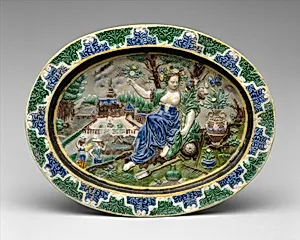
Dish with Pomona
late 16th or early 17th century
Medium
Lead-glazed earthenware
Dimensions
Overall (confirmed): 2 5/16 x 13 1/2 x 10 1/4 in. (5.9 x 34.3 x 26 cm)
Classification
Ceramics-Pottery
Culture
French, Fontainebleau or Avon
Department
European Sculpture and Decorative Arts
Museum
Metropolitan Museum of Art, New York, NY
Credit
Gift of Julia A. Berwind, 1953
Accession Number
53.225.60
Rights
Public Domain
Tags
Art Historical Context
This exquisite *Dish with Pomona*, crafted in lead-glazed earthenware during the late 16th or early 17th century, exemplifies the Renaissance fusion of art and nature in French decorative ceramics. Attributed to the innovative potter Bernard Palissy in collaboration with Flemish designers Maerten de Vos and engraver Philips Galle, it hails from the Fontainebleau or Avon region—near the royal Fontainebleau Palace, a hub of Mannerist artistry under French monarchs like Francis I. The dish's modest dimensions (2 5/16 x 13 1/2 x 10 1/4 in.) belie its grandeur, serving as both functional ware and a tabletop spectacle. At its center, the Roman goddess Pomona, protector of gardens and orchards, presides amid lush floral motifs, evoking abundance and the era's fascination with classical mythology and the natural world. Palissy's signature rustic style shines through the lead glaze, which provided vibrant, durable color and a glossy sheen ideal for intricate designs transferred from engravings. These ceramics were prized in elite households for their trompe-l'œil effects, blending molded reliefs with painted details to mimic reality. A gift to the Metropolitan Museum of Art in 1953, this piece highlights the cross-cultural exchanges between French potters and Northern engravers, underscoring ceramics' rise as an accessible yet sophisticated medium in Europe's courts. Visitors will appreciate how it captures the Renaissance ideal of *virtù*—the celebration of beauty in everyday luxury.
About the Artist
Bernard Palissy|Maerten de Vos|Philips Galle · 1510–1590
Bernard Palissy (c. 1510–1590), born to a poor family in the Saintonge region of France—possibly in Saintes, Périgord, or near Agen—began his career apprenticed to a glass painter before becoming a wandering journeyman portrait painter, glassworker, and land surveyor across France, the Low Countries, and Italy. He learned the rudiments of pottery in La Chapelle-des-Pots and settled in Saintes as a...