
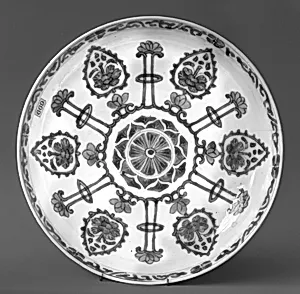
Dish with stylized flower scrolls
Unknown Artist
18th century
Medium
Porcelain painted in underglaze cobalt blue and café-au-lait glaze (Jingdezhen ware)
Dimensions
Diam. 8 1/2 in. (21.6 cm)
Classification
Ceramics
Culture & Period
China · Qing dynasty (1644–1911), Kangxi period (1662–1722)
Department
Asian Art
Museum
Metropolitan Museum of Art, New York, NY
Credit
Purchase by subscription, 1879
Accession Number
79.2.448
Rights
Public Domain
Art Historical Context
This elegant dish, featuring stylized flower scrolls in underglaze cobalt blue, the masterful porcelain production of Jingdezhen, China's renowned ceramics capital, during the Kang period (1662–1722) of the Qing dynasty.ed in the 18th century its café-au-lait glaze—a warm, milky-brown hue achieved through precise firing techniques—provides a subtle backdrop that highlights the intricate blue motifs. With a diameter of just 8½ inches, it was likely used for serving delicacies or as a decorative item in elite households. Jingdezhen ware reached new heights under Emperor Kangxi, whose patronage spurred innovation and export to Europe, blending traditional Chinese aesthetics with global appeal. The underglaze cobalt blue technique, where pigments are applied to the unfired clay before glazing and high-temperature firing, ensured vibrant, durable colors that wouldn't fade. These flower scrolls reflect stylized floral designs popular in imperial porcelain, symbolizing prosperity and harmony in Chinese culture. Acquired by subscription in 1879, this dish at the Metropolitan Museum of Art offers a window into Qing-era artistry, showcasing how technical virtuosity elevated everyday objects into treasures of enduring beauty.