
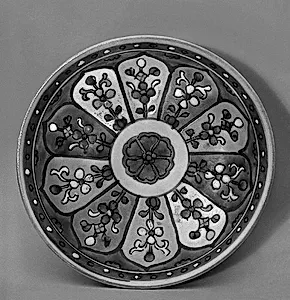
Dish with floral pattern
Unknown Artist
19th century
Medium
Porcelain painted in overglaze polychrome enamels (Bencharong ware for Thai market)
Dimensions
H. 1 1/4 in. (3.2 cm); Diam. 4 1/2 in. (11.4 cm)
Classification
Ceramics
Culture & Period
China · Qing dynasty (1644–1911)
Department
Asian Art
Museum
Metropolitan Museum of Art, New York, NY
Credit
Avery Fund, 1909
Accession Number
09.70.105
Rights
Public Domain
Art Historical Context
This delicate porcelain dish, adorned with a vibrant floral pattern, hails from China's Qing dynasty (16441911), specifically the 19th century Measuring just 1¼ inches high and 4½ in diameter, it exemplifies the exquisite finesse of imperial-era ceramics produced in Jingdezhen, the world's porcelain capital. The overglaze polychrome enam—fired at lower temperatures after glazing—lend the flowers their vivid hues of red, green, blue, and gold, creating a luminous effect that catches the light beautifully. Known as Bencharong ware ("five colors" in Thai), this dish was custom-made in China for the elite Thai market, reflecting thriving Sino-Thai trade networks. These pieces, often commissioned by Thai royalty, featured motifs like blooming lotuses and peonies symbolizing prosperity and harmony. The technique of overglaze enameling allowed for intricate, multi-layered designs not possible with underglaze methods, showcasing the potters' mastery and the era's export artistry. Acquired by the Metropolitan Museum of Art in 1909 through the Avery Fund, this dish offers a window into cross-cultural luxury. It highlights how Qing porcelain bridged East Asian traditions, blending Chinese technical prowess with Thai aesthetic preferences for bold, festive decoration. A true gem for lovers of Asian ceramics!