
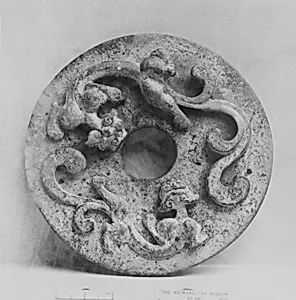
Disk
Unknown Artist
Medium
Jade
Dimensions
Diam. 5 in. (12.7 cm)
Classification
Jade
Culture & Period
China · Han dynasty (206 B.C.–A.D. 220)
Department
Asian Art
Museum
Metropolitan Museum of Art, New York, NY
Credit
Rogers Fund, 1923
Accession Number
23.76
Rights
Public Domain
Tags
Art Historical Context
This exquisite jade disk, known as a *bi*, hails from China's Han dynasty (206 B.–A.D. 220), a golden age of imperial expansion, Confucianism, and refined craftsmanship. Carved from nephrite jade—a material revered for its luminous translucence, durability, and symbolic ties to purity and immortality—the disk measures 5 inches in diameter. Its smooth, circular form with a central perforation is iconic, representing the heavens in ancient Chinese cosmology and often used in ritual ceremonies or as grave goods to connect the living with the divine. Han dynasty jade carvers mastered intricate techniques, polishing surfaces to a glassy sheen while incising delicate motifs, as suggested by the disk's association with mythical creatures like dragons or phoenixes. These fantastical beings embodied cosmic forces, warding off evil and ensuring harmony. Such objects underscore jade's cultural supremacy in China, outshining even gold, and reflect the era's blend of Taoist mysticism and bureaucratic order. Acquired through the Rogers Fund in 1923, this disk now graces the Metropolitan Museum of Art's Asian Art collection, inviting visitors to ponder the Han elite's quest for eternity through art.