
Disk Brooch
Unknown Artist
late 6th–early 7th century
Medium
Gold, wire, paste, paste cabochon or garnet, copper alloy rim and nail
Dimensions
Overall: 1 x 5/16 in. (2.6 x 0.8 cm)
Classification
Metalwork-Gold
Culture
Frankish
Department
Medieval Art
Museum
Metropolitan Museum of Art, New York, NY
Credit
Gift of J. Pierpont Morgan, 1917
Accession Number
17.191.157
Rights
Public Domain
Art Historical Context
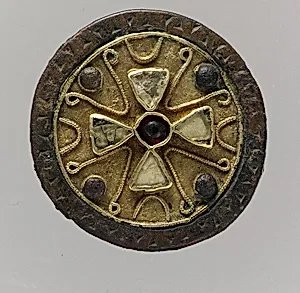
This exquisite Disk Brooch, crafted by an unknown Frankish artisan in the late 6th to early 7th century exemplifies the refined metalworking of early medieval Europe. just 1 x 5/16 inches (2.6 x 0.8 cm), this tiny jewel was likely used to fasten cloaks or garments, serving both practical and decorative purposes as a status symbol among the Frankish elite. Fashioned from gold with delicate wire elements, paste (a glass material mimicking gems), a paste cabochon or garnet and a copper alloy rim nail, it showcases the era's sophisticated techniques for creating luminous, jewel-like effects on a miniature scale. Hailing from the Merovingian Frankish culture—which dominated much of modern-day France and Germany—this brooch reflects a period of transition from late antiquity to the Middle Ages, marked by Germanic artistry blending Roman influences with local innovation. The use of imported or imitation garnets highlights extensive trade networks, while the gold's purity and precise construction underscore the wealth and skill of Frankish workshops. Now housed in the Metropolitan Museum of Art's Medieval Art Department as a gift from J. Pierpont Morgan in 1917, this brooch offers a glimpse into daily luxury for early medieval nobility. Its survival speaks to the enduring allure of such portable treasures, inviting us to marvel at the artistry compressed into something small enough to wear.