
Disk Brooch
Unknown Artist
ca. 550–600
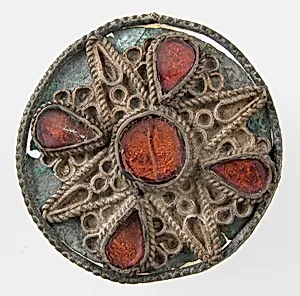
Medium
Copper alloy, silver wire, glass paste, remnant of iron pin
Dimensions
Overall: 1 1/4 x 3/8 in. (3.1 x 1 cm)
Classification
Metalwork-Copper alloy
Culture
Frankish or Northern French
Department
Medieval Art
Museum
Metropolitan Museum of Art, New York, NY
Credit
Gift of J. Pierpont Morgan, 1917
Accession Number
17.192.17
Rights
Public Domain
Art Historical Context
This exquisite Disk Brooch, crafted around 550–600 CE by an unknown Frankish or Northern French artisan, offers a glimpse into the daily elegance of early medieval Europe during the Merovingian period Measuring just 1¼ x ⅜ inches, these small, circular fasteners were essential accessories, used to secure cloaks or garments with a now-remnant iron pin. As part of the Frankish cultural sphere—spanning modern-day France, Germany, and beyond—such brooches symbolized both practicality and subtle status, worn by men and women alike in a world transitioning from Roman traditions to Germanic influences. The brooch's construction highlights remarkable metalworking skills: a copper alloy base adorned with silver wire and vibrant glass paste, likely inlaid for color and shine. These materials were locally sourced and ingeniously combined, reflecting the era's fusion of recycled Roman techniques with innovative Frankish designs. Glass paste, mimicking precious gems, added a touch of luxury without extravagance, showcasing the artisan's precision on such a miniature scale. Housed in the Metropolitan Museum of Art's Medieval Art Department since 1917, thanks to J. Pierpont Morgan's generous gift, this brooch survives as a testament to the artistry of ordinary objects. It invites us to appreciate how personal adornments preserved cultural identity amid the upheavals of the Migration Period.