
Disk Brooch
Unknown Artist
ca. 550–600
Medium
Copper alloy, silver wire, glass paste
Dimensions
Overall: 1 3/16 x 7/16 in. (3 x 1.1 cm)
Classification
Metalwork-Copper alloy
Culture
Frankish or Northern French
Department
Medieval Art
Museum
Metropolitan Museum of Art, New York, NY
Credit
Gift of J. Pierpont Morgan, 1917
Accession Number
17.192.81
Rights
Public Domain
Art Historical Context
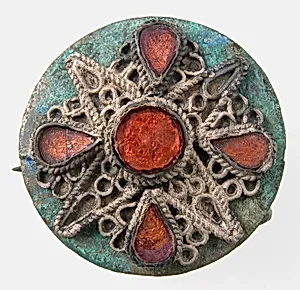
This exquisite Disk Brooch, dating to around 550–600 AD, hails from Frankish or Northern French culture the early Medieval period—a time when the Merovingian Franks were consolidating power in post-Roman Europe. Crafted as a small, functional piece of jewelry, it likely to fasten cloaks or garments, doubling as a status symbol for its wearer. Its diminutive size—barely over an inch across—belies the sophistication of early medieval metalworking traditions emerging after the fall of Rome. Made from copper alloy with delicate silver wire and vibrant glass paste, the brooch showcases techniques like inlaying colorful glass to mimic precious gems, a clever adaptation in an era of resource scarcity. The silver wire may have formed intricate borders or motifs, highlighting the artisan's skill in combining humble materials into something luminous and wearable. Now housed in the Metropolitan Museum of Art's Medieval Art Department, thanks to a 1917 gift from J. Pierpont Morgan, this brooch offers a tangible glimpse into daily life and artistic ingenuity among the Franks. It reminds us how everyday objects carried profound cultural weight, bridging pagan traditions and emerging Christian influences in early Europe.