
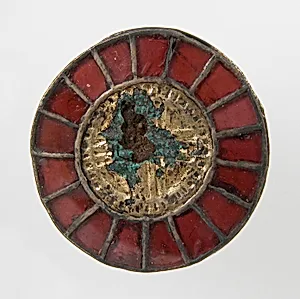
Disk Brooch
Unknown Artist
6th century
Medium
Silver-gilt, paste, gold leaf, remnant of iron pin
Dimensions
Overall: 13/16 x 5/16 in. (2.1 x 0.8 cm)
Classification
Metalwork-Silver
Culture
Frankish
Department
Medieval Art
Museum
Metropolitan Museum of Art, New York, NY
Credit
Gift of J. Pierpont Morgan, 1917
Accession Number
17.192.30
Rights
Public Domain
Art Historical Context
This exquisite Disk Brooch, crafted by an unknown Frankish artisan in the 6th century exemplifies the refined metalworking of the early Merovingian period. Measuring just 13/16 x 5/16 inches (2.1 x 0.8 cm), this jewel was likely used to fasten cloaks or garments, serving both practical and decorative purposes. Its circular form, typical of disk brooches popular among Germanic tribes during the Migration Period, reflects the fusion of Roman influences with emerging barbarian artistry in post-Roman Gaul. Fashioned from silver-gilt—a silver base coated with a thin layer of gold for a luxurious sheen—the brooch incorporates paste (likely imitative gems), gold leaf, and a remnant of an iron pin. These techniques highlight the Frankish skill in gilding and embellishment, creating affordable opulence for elites. Such pieces were status symbols, adorning the elite and signaling wealth amid the turbulent transition from late antiquity to the Middle Ages. A gift of J. Pierpont Morgan to the Metropolitan Museum of Art in 1917, this brooch offers a tangible glimpse into Frankish daily life and craftsmanship, bridging the artistry of a formative era in European history.