
Disk Brooch
Unknown Artist
6th century
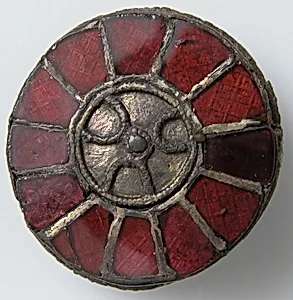
Medium
Silver, parcel gilt, foil and wire, glass paste or garnet
Dimensions
Overall: 1 1/16 x 3/8 in. (2.7 x 1 cm)
Classification
Metalwork-Silver
Culture
Frankish
Department
Medieval Art
Museum
Metropolitan Museum of Art, New York, NY
Credit
Gift of J. Pierpont Morgan, 1917
Accession Number
17.193.285
Rights
Public Domain
Art Historical Context
This exquisite Disk Brooch, crafted by an unknown Frankish artisan in the 6th century, the masterful metalwork of the early medieval Merovingian period. Measuring just 1 1/16 x 3/8 inches (2.7 x 1 cm), this tiny silver treasure—parcel gilt for a shimmering gold accent—was likely worn as a cloak fastener by a member of the elite. Frankish culture, emerging from the ruins of the Roman Empire in what is now France and Germany, blended Germanic traditions with lingering classical influences, and such brooches served as both practical adornments and symbols of status. The brooch's artistry shines in its sophisticated techniques: silver formed into a disk, enhanced with gold leaf via parcel gilding, delicate wire filigree, and reflective foil backing. Inlays of glass paste or garnets—prized for their fiery red hue—create a cloisonné-like effect, a hallmark of Migration Period jewelry that caught the light with every movement. Garnets, often sourced from distant trade routes like India via Byzantium, highlight the Franks' far-reaching networks. A gift to the Metropolitan Museum of Art from J. Pierpont Morgan in 1917, this brooch offers a glimpse into a transformative era, bridging antiquity and the Middle Ages while showcasing the ingenuity of anonymous craftsmen whose work adorned Europe's warrior nobility.