
Disk Brooch
Unknown Artist
mid-600s
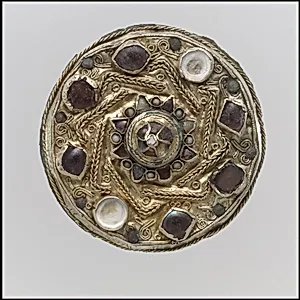
Medium
Gold; garnet; red, pale, amber and blue glass; mother-of-pearl
Dimensions
Overall: 1 3/4 x 7/8 in. (4.4 x 2.2 cm)
Classification
Metalwork-Gold
Culture
Frankish
Department
Medieval Art
Museum
Metropolitan Museum of Art, New York, NY
Credit
Gift of J. Pierpont Morgan, 1917
Accession Number
17.193.83
Rights
Public Domain
Art Historical Context
This exquisite Disk Brooch, crafted by an unknown Frankish artisan in the mid-600s, exemplifies the opulent metalwork of the Merovingian period in early medieval Europe. Measuring just 1 3/4 x 7/8 inches, this petite jewel was likely pinned to a garment, serving as both a functional fastener and a badge of elite status among Frankish nobility. Housed in the Metropolitan Museum of Art's Medieval Art department—thanks to a 1917 gift from J. Pierpont Morgan—it reflects the wealth and sophistication of the Franks under rulers like Clovis's successors. The brooch's gleaming gold base is adorned with intricate inlays of garnet, red, pale, amber, and blue glass, plus shimmering mother-of-pearl. These materials highlight advanced techniques like cloisonné or cellwork, where thin gold wires formed compartments filled with cut stones and glass for vibrant color contrasts. Garnets, prized for their deep red hue, were imported from distant sources, underscoring extensive trade networks across Europe and beyond. Culturally, such brooches symbolized power and piety in a Christianizing Frankish society, blending pagan ornamental traditions with emerging medieval aesthetics. Its survival offers a tangible glimpse into daily luxury for 7th-century aristocrats, reminding us how even small objects carried immense social weight.