
Finger Ring
Unknown Artist
500–550
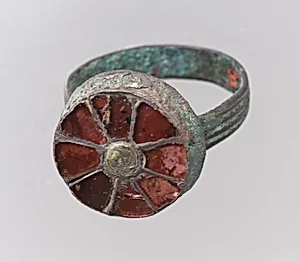
Medium
Gold, garnet, mother-of-pearl
Dimensions
Overall: 1 x 13/16 x 5/8 in. (2.5 x 2.1 x 1.6 cm) bezel: 5/8 x 1/4 in. (1.6 x 0.6 cm)
Classification
Metalwork-Gold
Culture
Frankish
Department
Medieval Art
Museum
Metropolitan Museum of Art, New York, NY
Credit
Gift of J. Pierpont Morgan, 1917
Accession Number
17.192.228
Rights
Public Domain
Art Historical Context
This exquisite Frankish finger ring, around 500–550 CE, exemplifies the masterful metalworking of the early Merovingian period. Made from gleaming gold with inlays of vibrant garnet and iridescent mother-of-l, its petite form—measuring just 1 x 13/16 x 5/8 inches overall—fits snugly on a finger. bezel, a raised oval platform (5/8 x 1/4 inches), likely held a gem or intaglio for sealing documents or as a personal emblem, highlighting the blend of utility and luxury in everyday adornment. In the turbulent world of post-Roman Gaul, the Franks rose as a dominant force under kings like Clovis I, and jewelry like this ring served as a status symbol for the elite. Garnet, sourced from distant trade routes, and mother-of-pearl added precious color and sheen through precise cloisonné-like techniques, where thin gold cells held the stones. Such rings often marked alliances, betrothals, or inheritance, reflecting a culture bridging pagan traditions and emerging Christianity. A generous gift from financier J. Pierpont Morgan in 1917, this piece now graces the Metropolitan Museum of Art's Medieval Art collection. It invites us to imagine a warrior-noble's hand, flashing wealth amid the forests and fortresses of early medieval Europe.