
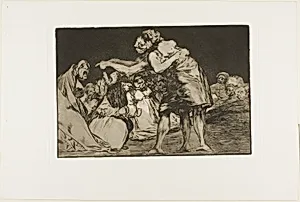
Disorderly Folly, plate seven from The Proverbs
1815/24, published 1864
Medium
Etching, aquatint and drypoint on ivory wove paper
Dimensions
Image: 21.8 × 32.5 cm (8 5/8 × 12 13/16 in.); Plate: 24.5 × 35.5 cm (9 11/16 × 14 in.); Sheet: 33.1 × 49.6 cm (13 1/16 × 19 9/16 in.)
Classification
etching
Department
Prints and Drawings
Museum
Art Institute of Chicago
Accession Number
129718
Rights
Public Domain
About this artwork
The double-bodied creature in this scene likely represents duplicity; literally two-faced, even its feet point in multiple directions. The distorted group kneeling beside the figure suggests a critique of misguided worship. This print has also been associated with the Spanish proverb “she who is ill wed never misses a chance to say so,” implying the folly of matrimony.
Art Historical Context
**Disorderly F**, plate seven from Francisco Goya's *The Proverbs* series (also known as *Los Proios*), captures the artist's biting satire on human absurdity. Created between 1815 and 1824 but published posthumously in 1864, this etching reflects Goya's late-career preoccupation with folly, vice, and societal decay. As a cornerstone of Romantic printmaking, Goya's work critiques the irrationality of Spanish life, drawing from proverbs to depict chaotic scenes of indulgence and madness—here evoking "disorderly folly" through shadowy figures in disarray. Goya masterfully combined etching for precise lines, aquatint for moody tonal depths, and drypoint for expressive, velvety textures on ivory wove paper. These techniques, honed in earlier series like *Los Caprichos*, allowed unprecedented dramatic contrast and emotional intensity, revolutionizing printmaking. Measuring about 22 x 33 cm, the image's intimate scale invites close scrutiny, revealing Goya's genius for blending realism with grotesque exaggeration. Housed in the Art Institute of Chicago's Prints and Drawings Department, this work underscores Goya's enduring cultural impact. Produced amid Spain's turbulent post-Napoleonic era and Goya's own deafness and isolation, *Disorderly Folly* immortalizes timeless warnings against human excess, reminding visitors of art's power to provoke reflection on our own "disorderly" impulses.
About the Artist
Francisco José de Goya y Lucientes · 1746–1828
Francisco José de Goya y Lucientes was born on March 30, 1746, in the small Aragonese village of Fuendetodos, Spain, to José Benito de Goya, a master gilder, and Gracia de Lucientes. The fourth of six children in a modest lower-middle-class family, Goya received a basic education before beginning his artistic training at age 14 under the local painter José Luzán y Martínez in Zaragoza, where he sp...