
Divina proportione
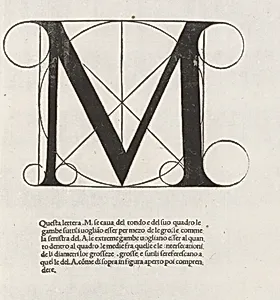
Medium
Book with woodcut illustrations
Dimensions
11 5/8 x 8 1/4 x 1 1/4 in. (29.6 x 21 x 3.1 cm)
Classification
Books
Department
Drawings and Prints
Museum
Metropolitan Museum of Art, New York, NY
Credit
Rogers Fund, 1919
Accession Number
19.50
Rights
Public Domain
Art Historical Context
"Divina proportione," published on June 1, 1509, stands as a remarkable Renaissance collaboration between mathematician Fra Luca Pacioli, artist Leonardo da Vinci, and printer Paganinus de Paganinus. This printed book, measuring just over 11 by 8 inches, features intricate woodcut illustrations that bring mathematical concepts to life through form. Its presence in the Metropolitan Museum’s Department of Drawings and Prints highlights the enduring value of works that bridge art and intellectual inquiry. The medium of woodcut illustration allowed for precise, repeatable images that captured the harmony of proportion and geometry central to the book’s theme. Leonardo’s contributions, rendered through this technique, exemplify his fascination with ideal forms and the natural world, rendered accessible to a broader audience via the printed page. Such books were prized not only for their content but also for their role in disseminating Renaissance ideas across Europe. Acquired by the museum through the Rogers Fund in 1919, this volume invites visitors to appreciate how early printed works combined scholarly rigor with artistic elegance, preserving knowledge that continues to inspire.
About the Artist
Leonardo da Vinci|Fra Luca Pacioli|Paganinus de Paganinus · 1452–1519
Leonardo da Vinci (1452-1519) stands as the quintessential Renaissance polymath, whose genius spanned painting, sculpture, architecture, science, mathematics, engineering, anatomy, geology, cartography, botany, and writing. Born in Vinci, Italy, as the illegitimate son of a notary, Leonardo received limited formal education but demonstrated extraordinary artistic talent from an early age. His appr...