
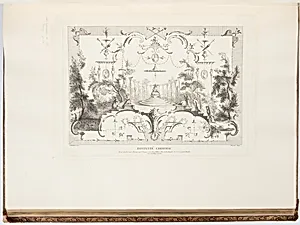
DIVINITÉ CHINOISE
1723-1735
Medium
Bound print
Classification
Bound print
Department
Smithsonian Collection
Museum
Smithsonian American Art Museum
Credit
Purchased for the Museum by the Advisory Council
Accession Number
1921-6-224-76
Rights
Public Domain
About this artwork
Research in Progress
Art Historical Context
**DIVINITÉ CHINOISE *Antoine Watteau (French, 1684–1721), 1723–1735* Bound print; Smithsonian American Art Museum oine Watteau, a master of the Rococo, is celebrated for his dreamy fêtes galantes—elegant outdoor scenes filled with amorous revelers. Yet *Divinité Chinoise* ("Chinese Divinity") reveals his playful engagement with chinoiserie, the 18th-century European with imagined Chinese aesthetics. Produced posthumously between 1723 and 1735, this bound print likely derives from Watteau's intricate drawings, translated into engraving by skilled printmakers. Watteau's death in 1721 at age 36 only amplified his legacy, as his designs fueled a booming print market that disseminated his whimsical visions across Europe. As a bound print, this work exemplifies the era's innovative reproductive techniques, where copperplate engravings captured fine details like flowing robes and exotic motifs on affordable, collectible volumes. Chinoiserie blended fantasy with luxury, adorning everything from porcelain to wallpaper, and Watteau's touch added a sensual, theatrical flair. Purchased for the Smithsonian American Art Museum by the Advisory Council, it highlights cross-cultural exchanges in art history. Though research continues, *Divinité Chinoise* invites us to ponder Watteau's boundless imagination—bridging French elegance with Eastern allure in a delicate, enduring print. (198 words)