
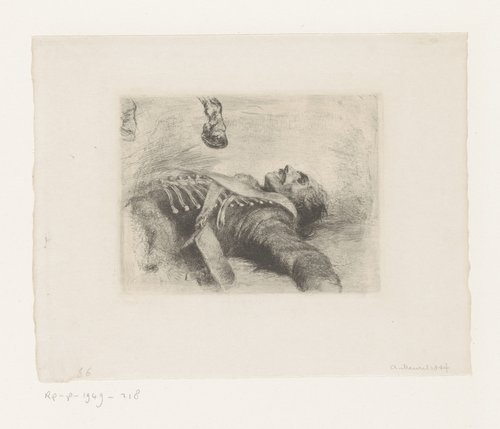
Dode huzaar
1844
Medium
etching
Dimensions
163; 125
Rights
Public Domain
About this artwork
date
Art Historical Context
Adolph Menzel's *Dode Huzaar* (1844) is a striking etching capturing a poignant moment, likely depicting a fallen hussar in intimate detail. Measuring just 125 mm high by 163 mm wide, this small-scale print exemplifies Menzel's mastery of etching—a labor-intensive intaglio technique where acid bites into a metal plate to create fine, expressive lines. As a leading figure in 19th-century German Realism, Menzel used etching to explore everyday heroism and tragedy with unflinching precision, often drawing from historical and military subjects. Created during the mid-1840s, amid Europe's simmering political tensions before the 1848 revolutions, the work reflects Menzel's fascination with Prussian military life. His etchings from this period, produced in his twenties, showcase his virtuosic draftsmanship, blending dramatic lighting and texture to evoke emotion in compact compositions. Etching allowed Menzel to achieve remarkable depth and subtlety, making *Dode Huzaar* a gem for collectors and a window into Romantic-era interest in valor and mortality. This piece highlights Menzel's early brilliance, bridging Neoclassicism and emerging Realism, and invites visitors to ponder the human cost of conflict through its meticulous artistry.
About the Artist
Adolph Menzel · 1815–1905
Adolph Menzel (1815–1905) was a German painter, draftsman, and printmaker who became the most celebrated German artist of the nineteenth century and one of the most technically accomplished realists in European art. Born Adolph Friedrich Erdmann von Menzel in Breslau (now Wroclaw, Poland), he moved to Berlin as a teenager and was largely self-taught, taking over his father's lithographic business ...