
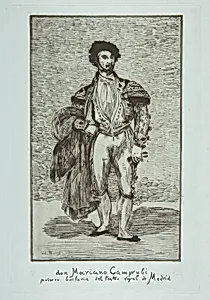
Don Mariano Camprubi (Le Baïlarin)
1862–63
Medium
Etching on blue laid paper, only state
Dimensions
plate: 11 3/4 x 7 3/4in. (29.8 x 19.7cm) sheet: 17 5/8 x 11 5/8in. (44.8 x 29.5cm)
Classification
Prints
Department
Drawings and Prints
Museum
Metropolitan Museum of Art, New York, NY
Credit
Rogers Fund, 1921
Accession Number
21.76.14
Rights
Public Domain
Tags
Art Historical Context
Édouard Manet’s *Don Mariano CamprubiLe Baïlarin)*, created between 1862 and 1863, captures the poised elegance of a male dancer in a striking etching on blue laid paper—the only state of this print, making each impression uniquely valuable. Measuring nearly 12 by 8 inches on the plate, this work from the Metropolitan Museum of Art’s Drawings and Prints department showcases Manet’s early mastery of printmaking during a pivotal moment in his. As a precursor to Impressionism, Manet drew inspiration from Spanish masters like Velázquez, infusing his modern subjects with dramatic flair. The title, translating to “The Dancer,” portrays Mariano Camprubí, a Spanish performer whose fluid pose and expressive features evoke the vibrant world of 19th-century dance and theater. Etching, an intaglio technique where acid bites into a metal plate to create fine lines, allowed Manet to achieve rich tonal contrasts and subtle textures on the uncommon blue paper, which lends a cool, atmospheric depth. This rarity highlights his experimental approach, bridging painting and print traditions. Acquired through the Rogers Fund in 1921, this print reflects Manet’s fascination with performers and everyday modernity, offering visitors a window into the cultural exchanges between France and Spain. It’s a testament to his innovative spirit, inviting us to appreciate the artistry in motion frozen on paper.
About the Artist
Edouard Manet · 1832–1883
Édouard Manet (1832-1883) was a French painter who played a pivotal role in the transition from Realism to Impressionism, often called the 'Father of Modern Art.' Born into a wealthy Parisian family, Manet defied his father's wishes for a legal career to pursue painting, studying under academic artist Thomas Couture. His revolutionary works 'Le Déjeuner sur l'herbe' and 'Olympia' (both 1863) scand...