
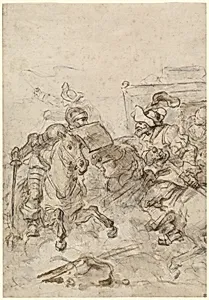
Don Quixote Attacking the Biscayan
Medium
brush with brown and gray washes over charcoal on laid paper
Dimensions
overall: 41.4 x 28.7 cm (16 5/16 x 11 5/16 in.)
Classification
Drawing
Department
CG-E
Museum
National Gallery of Art, Washington, D.C.
Credit
Gift of Gertrude Laughlin Chanler
Accession Number
2000.9.8
Rights
Public Domain
Art Historical Context
In the spirited drawing *Don Quixote Att the Biscayan*, Jeanonoré Fragonard a dynamic moment from Miguel de Cervantes' iconic novel *Don Quix*. Created in the 1780s, this work depicts the delusional knight-errant charging at his imagined foe, the Biscayan, embodying the novel's blend of comedy, chivalry, and chaos. Fragonard, a master of French Rococo art, infused his scenes with playful energy and theatrical flair, often drawing from literature to explore human folly and romance. Though best known for his lush oil paintings like *The Swing*, his drawings reveal a freer, more spontaneous side of his genius. Rendered in brush with brown and gray washes over charcoal on laid paper (41.4 x 28.7 cm), the piece showcases Fragonard's virtuoso technique. The washes add depth and movement, with fluid lines evoking the frenzy of battle, while the charcoal underdrawing provides bold contours. This mixed-media approach was ideal for rapid sketches, allowing the artist to convey emotion and drama with remarkable immediacy—hallmarks of Rococo draftsmanship amid the era's shift toward Neoclassicism. Housed in the National Gallery of Art's collection (gift of Gertrude Laughlin Chanler), this drawing highlights Fragonard's late-career fascination with *Don Quixote*, part of a series that celebrates the timeless appeal of Cervantes' satire. Visitors will appreciate its lively wit, a window into 18th-century France's love for whimsical storytelling.
About the Artist
Jean-Honoré Fragonard · 1732–1806
Jean-Honoré Fragonard (1732-1806) was a French painter and printmaker whose late Rococo manner was distinguished by remarkable facility, exuberance, and hedonism. Born in Grasse, he moved to Paris where he trained under Jean-Baptiste Chardin and François Boucher, winning the prestigious Prix de Rome in 1752. After studying in Italy alongside Hubert Robert, Fragonard returned to Paris in 1761 to fi...