
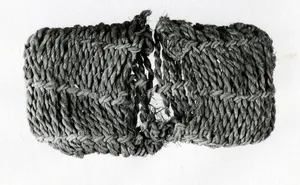
Donkey bag
Unknown Artist
ca. 2030–1640 B.C.
Medium
Reed rope
Dimensions
L. 11.5 × H. 11 cm (4 1/2 × 4 5/16 in.)
Classification
Donkey bag (broken)
Period
Middle Kingdom
Department
Egyptian Art
Museum
Metropolitan Museum of Art, New York, NY
Credit
Rogers Fund, 1926
Accession Number
26.3.160b
Rights
Public Domain
Art Historical Context
Step into the world of ancient Egypt with the *Donkey Bag*, a artifact from the Middle Kingdom Dynasty 11 (ca. 2030–1640 B.C.). Crafted from humble reed rope, this small—measuring just 11.5 cm long and 11 cm high—likely served as a practical carrying vessel, evoking the daily labors of Egyptian workers and traders who relied on donkeys for transport across the Nile Valley and beyond. Reed rope, woven from the abundant papyrus and reeds of the Nile, highlights the Egyptians' masterful resourcefulness. During the Middle Kingdom, a time of reunification and cultural revival under Theban rulers like Mentuhotep II, such utilitarian objects were often produced with precise plaiting techniques, blending functionality with subtle artistry. Though small, this bag offers a window into everyday life, where donkeys hauled goods vital to trade and agriculture, underscoring the period's economic stability and craftsmanship. Today, housed in the Metropolitan Museum of Art's Egyptian Art department (Rogers Fund, 1926), the *Donkey Bag* reminds us how even modest items illuminate the ingenuity of a civilization that built pyramids and temples. Its survival speaks to the enduring legacy of Middle Kingdom artisans.