
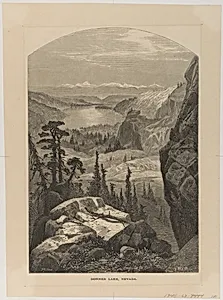
Donner Lake, Nevada
Medium
landscapes
Classification
landscapes
Department
Smithsonian Collection
Museum
Smithsonian American Art Museum
Credit
Gift of Gilbert White Rose and Henry Martin Rose II
Accession Number
1945-69-9444
Rights
Public Domain
About this artwork
Research in Progress
Art Historical Context
Thomas Moran's *Donner Lake, Nevada* (1874) captures the majestic beauty of the American West during a transformative era of national expansion. Born in Britain but a defining figure in American art, Moran (1837–1926) was a leading member of the Hudson River School, renowned for his luminous landscapes that celebrated the untamed wilderness. This work, housed in the Smithsonian American Art Museum as a gift from Gilbert White Rose and Henry Martin Rose II, exemplifies his ability to evoke the sublime scale of nature through sweeping vistas and dramatic light effects. Painted just years after the completion of the Transcontinental Railroad, *Donner Lake* reflects the growing fascination with the Sierra Nevada's rugged terrain—a site forever linked to the tragic Donner Party expedition of 1846–47. Moran's technique, often employing watercolor or oil with intricate detailing and atmospheric perspective, transformed sketches from his travels into powerful advocacy for preservation. His images influenced Congress's creation of Yellowstone National Park in 1872, underscoring art's role in shaping environmental policy. Visitors to the Smithsonian will appreciate how this piece immerses them in 19th-century America's spirit of discovery, blending artistic mastery with cultural history. Moran's vivid portrayal invites reflection on humanity's place amid nature's grandeur.