
Dood van Willem III
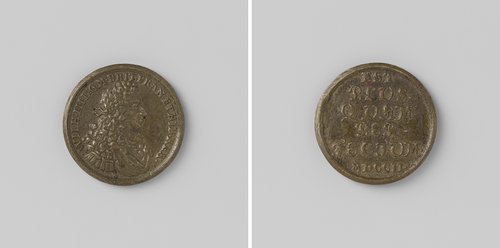
Medium
striking (metalworking)
Dimensions
2; 4.29
Rights
Public Domain
About this artwork
Gift of J.M. van Gelder-Nijhoff
Art Historical Context
**Dood van Willem III (Death of William III)** *Christian Wermuth,1702* *Struck medal: diameter 2 cm, 4.29 g* *Gift of J.M. van Gelder-Nijhoff* This struck medal by German engraver and medalist Christian Werm commemorates the death of William III, the Dutch stadtholder and King of England, Scotland, Ireland. Created in the very year of William's passing—1702—the piece captures a pivotal moment in European history. William, famed for his role in the Glorious Revolution and wars against Louis XIV, died unexpectedly at age 51 after a riding accident at Hampton Court Palace, marking the end of an era for Anglo-Dutch alliances. Wermuth, active in the Baroque tradition of intricate portraiture and allegory, employed the striking technique—hammering a detailed die into soft metal—to produce this petite yet precise artwork. At just 2 cm in diameter and weighing 4.29 grams, it exemplifies the artistry of 18th-century numismatics, where medals served as portable memorials blending historical record with fine craftsmanship. Such objects were prized by collectors for their dual role as art and propaganda. Today, this medal offers a tangible glimpse into the cultural reverence for William III in the Netherlands, reflecting national pride and mourning through miniature mastery. A generous gift from J.M. van Gelder-Nijhoff, it invites us to ponder how small-scale works preserve grand legacies.
About the Artist
Christian Wermuth · 1661–1739
Christian Wermuth (1661–1739) was a prolific and highly influential German medallist, coin engraver, bookseller, and publisher whose work epitomized the Baroque tradition of medallic art in the German territories. Born on December 16, 1661, in Altenburg and dying on December 3, 1739, in Gotha, Wermuth's career spanned nearly eight decades of intense artistic production, pedagogical influence, and ...