
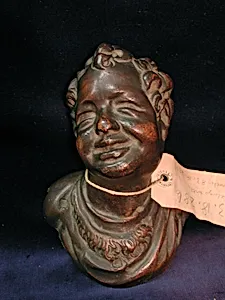
Door ornament
19th century, after 16th century original
Medium
Bronze
Dimensions
Height: 5 in. (12.7 cm)
Classification
Metalwork-Electrotype
Culture
British, after Italian original
Department
European Sculpture and Decorative Arts
Museum
Metropolitan Museum of Art, New York, NY
Credit
Gift of Henry G. Marquand, 1883
Accession Number
83.18.286
Rights
Public Domain
Tags
Art Historical Context
This exquisite bronze door ornament, titled *Door Ornament*, is a 19th-century electrotype reproduction of a 16th-century original the renowned Italian Renaissance sculptor and architect Jacopo Sansov (Jacopo Tatti, 1486–1570). Standing just 5 inches (12.7 cm) tall, it exemplifies Sansovino's mastery of classical forms, likely featuring intricate sculpted heads—common in Renaissance decorative metalwork for doors, evoking the grotesque or portrait-like motifs inspired by antiquity. Sansovino, a pivotal figure in Venetian Renaissance art, blended Florentine precision with High Renaissance grandeur, as seen in his architectural masterpieces like the Library of St. Mark's. This ornament reflects the era's fascination with functional yet artistic hardware, where bronze casts adorned elite palaces and churches, symbolizing wealth and humanist ideals. The electrotype technique, pioneered in the 19th century, allowed precise replication of fragile originals using electrolysis, making high art accessible to collectors and museums. Now housed in the Metropolitan Museum of Art's Department of European Sculpture and Decorative Arts—thanks to a gift from Henry G. Marquand in 1883—this British-made copy preserves Sansovino's legacy, bridging Renaissance Italy with Victorian admiration for the classical past. A delightful glimpse into how art history travels through time!