
Dordrecht
1870-1877
Medium
graphite on wove paper
Dimensions
sheet: 37.78 × 26.83 cm (14 7/8 × 10 9/16 in.)
Classification
Drawing
Department
CG-W
Museum
National Gallery of Art, Washington, D.C.
Credit
Corcoran Collection
Accession Number
2015.19.3547
Rights
Public Domain
Art Historical Context
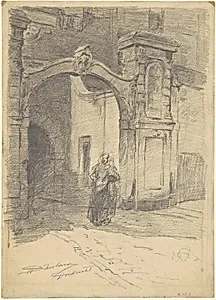
Walter Shirlaw’s “Dordrecht” offers a quiet, intimate glimpse of the historic Dutch city of the same name. Created between 1870 and 1877, the graphite drawing on smooth wove paper measures roughly 15 by 11 inches, its delicate lines and subtle tonal gradations suggesting a moment of careful observation during the artist’s European travels. As a work on paper rather than a finished painting, it reveals the private, exploratory side of an artist’s practice—where quick studies and detailed sketches often formed the foundation for larger compositions. Graphite’s versatility allowed Shirlaw to capture both architectural detail and atmospheric softness, lending the scene a sense of lived immediacy. The choice of medium underscores the drawing’s role as both document and artwork, preserving the textures of Dordrecht’s canals and buildings while inviting viewers to appreciate the quiet skill involved in rendering light and space with only pencil and paper. Now part of the National Gallery of Art’s Corcoran Collection, this piece reminds us how 19th-century artists used travel sketches to bridge cultures and refine their vision, offering today’s visitors a personal window into that creative process.
About the Artist
Walter Shirlaw · 1838–1909
Walter Shirlaw (1838–1909) was a Scottish-born American painter and illustrator whose career bridged the genteel tradition of academic figure painting and the emerging ambitions of American art in the Gilded Age. Born in Paisley, Scotland, Shirlaw emigrated to the United States as a child and received his early artistic training in America before traveling to Munich to study at the Royal Academy —...