
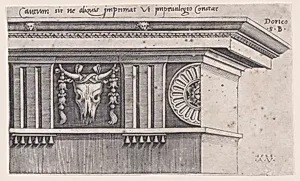
Doric Entablature
dated 1528
Medium
Engraving
Dimensions
4 5/16 x 7 3/16 in. (11.0 x 18.3 cm)
Classification
Prints
Department
Drawings and Prints
Museum
Metropolitan Museum of Art, New York, NY
Credit
Gift of Michel Benisovitch, 1930
Accession Number
30.42.3
Rights
Public Domain
Art Historical Context
Created in 1528 by the Italian engraver Agostino Veneziano, *Doric Entablature captures the precise architectural details of the Doric order, one of the foundational styles of classical Greek and Roman building. Measuring just over four by seven inches, this delicate print showcases the artist’s mastery of line work, rendering the architrave, frieze, and cornice with remarkable clarity and depth. Veneziano, active during the height of the Renaissance, specialized in reproductive engravings that translated architectural and sculptural forms into portable images. During the early sixteenth century, renewed fascination with antiquity drove artists and architects to study and record ancient ruins. Prints such as this one played a vital role in spreading knowledge of classical proportions across Europe, allowing builders and patrons far from Italy to study the Doric order’s harmonious ratios. Veneziano’s engraving thus served both as an artistic object and a practical reference, bridging the worlds of fine printmaking and architectural design. Today it offers visitors a window into how Renaissance creators revived and reinterpreted the architectural language of the ancient world.