
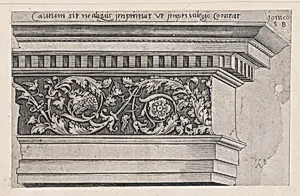
Speculum Romanae Magnificentiae: Ionic Entablature
Medium
Engraving
Dimensions
sheet: 4 9/16 x 7 5/16 in. (11.6 x 18.5 cm)
Classification
Prints
Department
Drawings and Prints
Museum
Metropolitan Museum of Art, New York, NY
Credit
Harris Brisbane Dick Fund, 1941
Accession Number
41.72(2.30)
Rights
Public Domain
Tags
Art Historical Context
This engraving by Agostino Veneziano, created in 1528, captures the elegant details of an Ionic entablature, a key element of classical Roman architecture. As part of the ambitious series *Speculum Romanae Magnificentiae* (“Mirror of Roman Magnificence”), the print documents ancient architectural forms with remarkable precision. Veneziano, a skilled Venetian engraver active during the High Renaissance, specialized in reproductive prints that translated sculptural and architectural motifs into portable, widely circulated images. The work reflects the Renaissance fascination with antiquity, when artists and architects sought to revive the proportional systems of ancient Rome. By rendering the Ionic order’s distinctive frieze, cornice, and decorative moldings, Veneziano helped disseminate knowledge of classical design across Europe. Engravings like this one played a vital role in architectural education, allowing scholars and builders who could not travel to Rome to study its monuments in detail. Measuring just over seven inches wide, the small sheet demonstrates the medium’s capacity for fine line work and intricate ornament. Today housed in the Metropolitan Museum of Art, it remains a valuable record of how Renaissance printmakers bridged the ancient and modern worlds.