
Édouard Manet
Medium
Oil on canvas
Dimensions
117.5 × 90 cm (46 1/4 × 35 7/16 in.); Framed: 143.6 × 115 × 11.5 cm (56 1/2 × 45 1/4 × 4 1/2 in.)
Classification
oil on canvas
Department
Painting and Sculpture of Europe
Museum
Art Institute of Chicago
Accession Number
87467
Rights
Public Domain
About this artwork
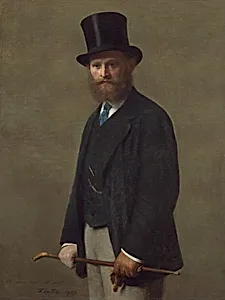
Finely dressed and carrying an elegant walking stick, influential French artist Édouard Manet appears before a stark background evocative of his own paintings as well as photographic portraits of the time. Created by his friend Henri Fantin-Latour, this depiction confronted the public perception of Manet as a radical bohemian painter of coarse and confrontational compositions (for an example of this, see his Jesus Mocked by the Soldiers). Fantin-Latour instead portrayed him as the genteel man-ab...
Art Historical Context
Henri Fantin-Latour's *Édouard Manet* (1867) is a striking oil-on-canvas portrait that captures the essence of one of modern art's pivotal figures. Measuring 117.5 × 90 cm, this large-scale work depicts the French painter Édouard Manet seated confidently, his intense gaze and modern attire reflecting his bold challenge to artistic conventions. Created by Fantin-Latour, a close friend and fellow Realist, the painting hangs in the Art Institute of Chicago's Department of Painting and Sculpture of Europe, exemplifying 19th-century portraiture at its finest. Painted in Paris during a transformative era, the portrait coincides with Manet's controversial Salon submissions like *Olympia* (1865), which scandalized audiences by blurring lines between Realism and emerging Impressionism. Fantin-Latour, renowned for his precise, luminous group portraits of artists—such as *Homage to Delacroix* (1864)—here immortalizes Manet as a central innovator. The oil medium allows for rich textures in Manet's clothing and subtle modeling of his face, highlighting Fantin-Latour's meticulous technique and admiration for his subject's revolutionary spirit. This artwork offers a window into the vibrant artistic circles of 1860s France, where friendships fueled modernism. Today, it reminds visitors of Manet's enduring legacy as a bridge to Impressionism, inviting us to ponder the personal bonds behind artistic upheaval.
About the Artist
Henri Fantin-Latour · 1836–1904
Ignace Henri Jean Théodore Fantin-Latour was born on January 14, 1836, in Grenoble, France, to portrait painter Théodore Fantin-Latour, who gave him his earliest drawing lessons. The family relocated to Paris in 1841, where in 1850, at age 14, he enrolled in the École de Dessin, studying under Horace Lecoq de Boisbaudran, whose innovative memory-based method of drawing from observation profoundly ...