
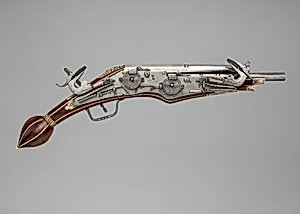
Double Barrelled Wheellock Pistol
Unknown Artist
dated 1612
Medium
Steel, wood, staghorn
Dimensions
L. 20 3/8 in. (51.75 cm); L. of upper barrel 9 1/2 in. (24.1 cm); L. of lower barrel 9 3/8 in. (23.8 cm); Cal. of upper barrel .43 in. (10.8 mm); Cal. of lower barrel .54 in. (13.6 mm); Wt. 3 lb. 15.5 oz. (1800.2 g)
Classification
Firearms-Pistols-Wheellock
Culture
German
Department
Arms and Armor
Museum
Metropolitan Museum of Art, New York, NY
Credit
Rogers Fund, 1904
Accession Number
04.3.194
Rights
Public Domain
Art Historical Context
Step into the Arms and Armor gallery to encounter this remarkable *Double Barrelled Wheellock Pistol* from 1612, a German masterpiece of early firearm engineering. Crafted from steel for its robust barrels and mechanism, wood for the sturdy stock, and staghorn for ergonomic, tactile grips, this pistol measures 20⅜ inches long and weighs nearly four pounds. Its superimposed double barrels— the upper with a .43-inch caliber and the lower .54-inch—allowed for two rapid shots, a rare innovation for self-defense, dueling, or cavalry use. Wheellock pistols, pioneered in 16th-century Europe and perfected in German workshops, represented a technological leap. Unlike matchlocks reliant on slow-burning fuses, the wheellock used a spring-driven steel wheel to spark flint, enabling reliable ignition even in wet conditions. Dating to 1612, this piece hails from the eve of the Thirty Years' War, when such finely made arms symbolized status and martial prowess among nobility and officers. Acquired through the Rogers Fund in 1904, this pistol at the Metropolitan Museum of Art showcases the exquisite metalworking and joinery of Renaissance gunsmiths. Its compact power and dual-barrel design highlight how firearms evolved from battlefield curiosities into essential tools of early modern warfare, blending deadly function with artisanal elegance.