
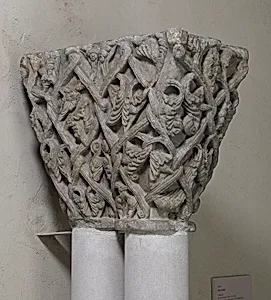
Double Capital with Vine Tendrils
Unknown Artist
1170–80
Medium
Marble
Dimensions
Overall: 15 3/4 x 18 x 10 1/2 in. (40 x 45.7 x 26.7 cm)
Classification
Sculpture-Architectural
Culture
French
Department
Medieval Art
Museum
Metropolitan Museum of Art, New York, NY
Credit
Rogers Fund, 1951
Accession Number
51.124
Rights
Public Domain
Art Historical Context
This exquisite *Double Capital with Vine Tendrils*, carved from marble around 1170–80 in France, exemplifies the refined stonework of the late Romanesque period. Architectural capitals like this crowned the tops of columns in grand cathedrals and abbeys, supporting arches while serving as canvases for symbolic decoration. Measuring about 16 by 18 inches, this double example—likely from a church interior—showcases the anonymous mason's mastery in transforming solid stone into delicate, flowing forms. The surface bursts with intertwining vine tendrils, a motif evoking the Garden of Eden, spiritual growth, and eternal life in medieval Christian art. Carved in high relief, the tendrils twist and curl with naturalistic precision, highlighting the French sculptors' shift toward more organic designs that bridged Romanesque solidity and the budding Gothic lightness. Such details demanded exceptional skill with chisels and abrasives, revealing the collaborative genius of monastic workshops. Today, housed in The Metropolitan Museum of Art's Medieval Art department (acquired via the Rogers Fund in 1951), this capital invites us to imagine the candlelit naves where it once stood, whispering tales of faith and craftsmanship from 12th-century France.