
Double Irish Chain
ca. 1910
Medium
Decorative Arts-Fiber
Classification
Decorative Arts-Fiber
Department
Smithsonian Collection
Museum
Smithsonian American Art Museum
Credit
Smithsonian American Art Museum, Gift of Iris and Jay Leonard and Kohler Foundation, Inc.
Accession Number
2013.67.2
Rights
Public Domain
Art Historical Context
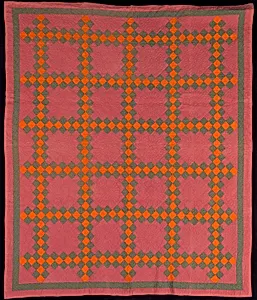
Welcome to the Smithsonian American Art Museum, where the **Double Irish Chain** quilt (ca. 1910) invites you into the world of early 20th-century American fiber arts. Crafted by an unidentified artist, this piece exemplifies the timeless tradition of pieced quilting, a medium where scraps of fabric are meticulously sewn into intricate patterns. Likely made from cotton or wool blends common to the era, it showcases the "Double Irish Chain" design—a bold geometric motif featuring interlocking chains of alternating light and dark squares and rectangles, evoking chains or ladders that symbolize unity and continuity. Quilting flourished in America during this period as both a practical necessity and a creative outlet, especially among rural women who gathered in "quilting bees" for communal craftsmanship. By 1910, sewing machines were increasingly used alongside hand-stitching, allowing for finer details and larger works. This quilt reflects the ingenuity of everyday makers, transforming humble materials into durable bedcovers or heirlooms that doubled as storytelling canvases. Housed in the Smithsonian's Decorative Arts-Fiber collection, thanks to a gift from Iris and Jay Leonard and Kohler Foundation, Inc., the **Double Irish Chain** highlights folk art's rise in museum esteem. It underscores how anonymous creators contributed to America's rich textile heritage, blending utility with artistic harmony in a pre-industrial age. A true gem of cultural endurance!
About the Artist
Unidentified ( ) · –