
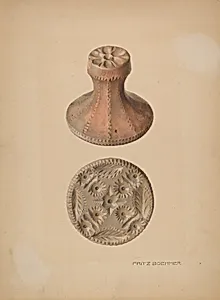
Double Mold
c. 1938
Medium
watercolor, graphite, colored pencil, and heightening on paperboard.
Dimensions
overall: 38 x 27.9 cm (14 15/16 x 11 in.) Original IAD Object: 3 3/4" High 4 1/8" Dia.(base) 2" Dia.(top)
Classification
Index of American Design
Department
CG-W
Museum
National Gallery of Art, Washington, D.C.
Credit
Index of American Design
Accession Number
1943.8.5105
Rights
Public Domain
Art Historical Context
**Double Mold**, a meticulously rendered study by Fritz Boehmer around 1938, captures the simplicity of an everyday American artifact. Created as part of the Index of American Design (IAD)—a landmark WPA Federal Art Project during the Great Depression—this watercolor, graphite, colored pencil and heightening on paper (38 x 27.9 cm) exemplifies program's mission to document and celebrate the nation's folk art and material culture. Boehmer's precise draftsmanship brings to life a modest double mold object, standing 3¾ inches high with a 4⅛-inch base diameter tapering to 2 inches at the top, suggesting its use in crafting symmetrical forms like candles, soaps, or ceramics. The IAD, involving over 200 artists, produced thousands of such vivid index cards to preserve vanishing traditions amid economic hardship, influencing later appreciation of American design. Boehmer's multifaceted technique—layering translucent watercolors for depth, graphite for fine lines, and colored pencils for subtle hues—heightens the object's three-dimensionality, making the functional form gleam with artistic vitality. Housed in the National Gallery of Art's collection, *Double Mold* invites us to marvel at the ingenuity of anonymous makers, bridging utilitarian craft with cultural heritage. It's a charming reminder of how ordinary tools shaped American life.
About the Artist
Fritz Boehmer · 1875–1942
Fritz Boehmer (1875–1942) was a Czech-born American painter whose career bridged personal portraiture and public documentation of folk art traditions. Little is known about his early life or formal training, which remains sparsely documented; however, by 1895, he was producing intimate portraits, such as *Gertrud Boehmer* at the Toledo Museum of Art, suggesting skill in miniature and figure work h...