
Double Saddle Bag (Khorjin)
Unknown Artist
ca. 1900
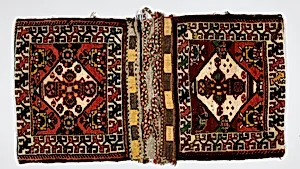
Medium
Wool (warp, weft, and pile); symmetrically knotted pile and slit tapestry (kilim) closure (front); weft-faced plain weave with twined and braided loop closures (back)
Dimensions
H. 42 in. (106.7 cm) W. 23 in. (58.4 cm)
Classification
Textiles-Woven
Department
Islamic Art
Museum
Metropolitan Museum of Art, New York, NY
Credit
Gift of Inger G. and William B. Ginsberg, 2015
Accession Number
2015.490.32
Rights
Public Domain
Art Historical Context
This exquisite Double Saddle Bag, or *khorjin*, dates to around 1900 and originates from the rich textile traditions of Islamic nomadic cultures, likely in Central Asia or Persia.ed for practical use by pastoral herders, these double-compartment bags were strapped over saddles on horses or camels to balance loads household goods, grain, or clothing during migrations. Measuring an impressive 42 inches high and 23 inches, it reflects the ingenuity of mobile communities who wove beauty into everyday necessities. The front showcases a symmetrically knotted pile—a durable knotted technique akin to pile rugs—for the main body, paired with a slit tapestry (kilim) closure that creates bold, geometric patterns through interlocking wefts. The back employs a weft-faced plain weave with twined and braided loop closures, adding strength and functionality. These methods highlight the weavers' skill in wool manipulation, blending sumptuous texture with structural resilience. As a gift to the Metropolitan Museum of Art's Islamic Art department, this *khorjin* offers a window into early 20th-century nomadic life, where art served survival. Visitors can appreciate how such textiles preserved cultural identity amid constant movement.