
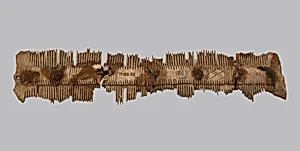
Double-Sided Comb
Unknown Artist
7th century
Medium
Bone
Dimensions
Overall: 7 x 1 3/8 x 1/2 in. (17.8 x 3.5 x 1.3 cm)
Classification
Bone
Culture
Frankish
Department
Medieval Art
Museum
Metropolitan Museum of Art, New York, NY
Credit
Gift of J. Pierpont Morgan, 1917
Accession Number
17.193.53
Rights
Public Domain
Art Historical Context
This exquisite double-sided comb, crafted from bone in 7th-century Frankish culture, offers a glimpse into the daily lives of early medieval Europeans. Measuring just 7 x 1 3/8 x 1/2 inches, its compact form was ideal for personal grooming during the Merovingian period when the Franks dominated much of Western Europe under kings like Clovis's successors. Bone, a readily available and durable material sourced from animal remains, was prized for such utilitarian objects, showcasing skilled carving techniques that balanced functionality with subtle elegance. The comb's double-sided design—one side likely featuring finer teeth for removing lice and nits, the other coarser for detangling hair—highlights hygiene practices in a time before modern sanitation. As a Frankish artifact in the Metropolitan Museum of Art's Medieval Art collection (gift of J. Pierpont Morgan, 1917), it reflects the craftsmanship of anonymous artisans whose work bridged pagan traditions and emerging Christian influences. These combs were not mere tools but status symbols, often buried with their owners, underscoring grooming's role in Frankish identity and social rituals. A small treasure that speaks volumes about an era's ingenuity.