
Double-Sided Gospel Leaf
Unknown Artist
first half 14th century
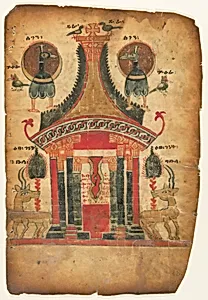
Medium
Tempera on parchment
Dimensions
Overall: 10 15/16 x 7 1/2 in. (27.8 x 19 cm) Overall (Framed): 18 1/8 x 14 3/8 x 3/4 in. (46 x 36.5 x 1.9 cm)
Classification
Manuscripts and Illuminations
Culture
Ethiopian
Department
Medieval Art
Museum
Metropolitan Museum of Art, New York, NY
Credit
Purchase, Oscar de la Renta Ltd. Gift, 2006
Accession Number
2006.100
Rights
Public Domain
Tags
Art Historical Context
This double-sided Gospel leaf, created in Ethiopia during the first half of the fourteenth century, offers a vivid window into the rich tradition of medieval Christian manuscript illumination. Painted in tempera on parchment, the leaf once formed part of a larger Gospel book, its compact size—roughly 11 by 7½ inches—ideal for intimate reading during church services or private devotion. The medium’s luminous colors and fine detail allowed artists to bring biblical narratives to life on both sides of the page, a practical yet beautiful solution in an era when books were laboriously copied by hand. Ethiopian illuminated manuscripts like this one played a central role in preserving and transmitting Christian teachings across generations. They blended Byzantine influences with distinctly local artistic conventions, featuring bold outlines, vibrant palettes, and stylized figures that emphasized spiritual meaning over naturalistic representation. The presence of men, birds, and animals among the imagery suggests lively narrative scenes, possibly from the life of Christ or symbolic motifs common in Ethiopian Gospel cycles. Acquired by the Metropolitan Museum of Art in 2006, this leaf exemplifies the enduring vitality of Ethiopia’s manuscript tradition and invites visitors to appreciate the skill and devotion behind these portable treasures of faith.