
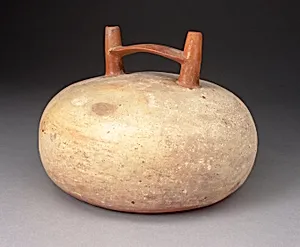
Double Spout and Bridge Bottel Painted with Cream and Orange Slips
650–150 BCE
Medium
Ceramic and pigment
Dimensions
13.7 × 19.1 cm (5 3/8 × 7 1/2 in.)
Classification
earthenware
Department
Arts of the Americas
Museum
Art Institute of Chicago
Accession Number
20276
Rights
Public Domain
Art Historical Context
This striking Double Spout and Bridge Bottle, crafted by artisans of the Paracas culture on Peru's south coast between 650 and 150 BCE, exemplifies the ingenuity of Pre-Columbian ceramics. Measuring just 13.7 × 19.1 cm, this earthenware vessel features a double-spout design connected by a bridge handle—a clever form that allowed liquids to be poured from one spout while air entered the other, preventing spills. Its surface is adorned with cream and orange slips, thin layers of pigmented clay applied before firing to create durable, vibrant colors that have endured for over two millennia. The Paracas, named after the peninsula where their necropolis was discovered, were master ceramicists whose works bridged earlier Andean traditions and later Nazca styles. These slips not only provided a glossy finish but also enabled bold decorative patterns, often evoking supernatural themes central to Paracas cosmology. Though specific motifs on this bottle aren't detailed, the technique highlights their advanced control of firing temperatures to achieve rich hues without glazes. Housed in the Art Institute of Chicago's Arts of the Americas collection, this bottle offers a window into Paracas ritual life, where such vessels likely held chicha (fermented corn beer) for ceremonies. Its compact elegance underscores the culture's blend of utility and artistry, inviting us to marvel at ancient hands shaping enduring beauty.