
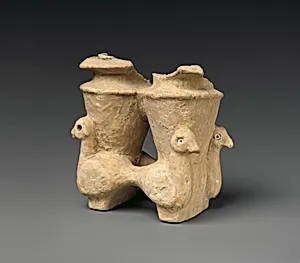
Double vessel with duck-shaped supports
Unknown Artist
ca. 2600–2500 BCE
Medium
Gypsum alabaster, shell inlay, bitumen
Dimensions
4 3/8 x 2 1/2 x 4 1/8 in. (11 x 6.2 x 10.5 cm)
Classification
Stone-Vessels
Culture & Period
Sumerian · Early Dynastic IIIa
Department
Ancient Near Eastern Art
Museum
Metropolitan Museum of Art, New York, NY
Credit
Rogers Fund, 1962
Accession Number
62.70.3
Rights
Public Domain
Tags
Art Historical Context
Step into the world of ancient Sumer with this exquisite *Double Vessel with Duck-Shaped Supports*, crafted around 2600–2500 BCE during the Early Dynastic III period. Hailing from the innovative city-states of Mesopotamia, small gypsum alabaster vessel—measuring just 4 3/8 x 2 1/2 x 4 1/8 inches—features two connected compartments elevated by playful duck figures. These stone vessels were prestige objects, likely used by elites to hold precious oils, perfumes, or liquids, showcasing Sumerian mastery in everyday luxury. The artist's anonymous skill shines in the fine carving of the soft, luminous alabaster, a material prized for its workability and sheen. Shell inlays add vivid detail, probably to the ducks' eyes or features, while bitumen sealed joints for practicality. Duck motifs evoke the watery abundance of Sumerian rivers and marshes, symbols of fertility in a land dependent on irrigation. This piece highlights the Early Dynastic era's artistic peak, just before grand ziggurats rose, blending function, form, and subtle symbolism. Today, at the Metropolitan Museum of Art (Rogers Fund, 1962), it whispers of a civilization that birthed writing and urban life—hold its delicate scale in your mind's eye!