
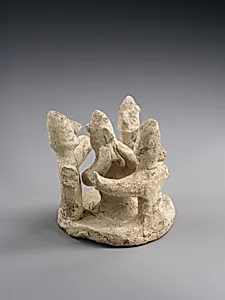
Terracotta statuette of a ring dance
Unknown Artist
6th century BCE
Medium
Terracotta
Dimensions
H. 3 3/4 in. (9.5 cm)
Classification
Terracottas
Culture & Period
Cypriot · Cypro-Archaic II
Department
Greek and Roman Art
Museum
Metropolitan Museum of Art, New York, NY
Credit
The Cesnola Collection, Purchased by subscription, 1874–76
Accession Number
74.51.1650
Rights
Public Domain
Tags
Art Historical Context
This charming terracotta statuette, titled *Terracotta Statuette of a Ring*, captures a lively moment of communal joy from ancient Cyprus in the 6th century BCE. Standing just 3 3/4 inches (9.5 cm) tall, it depicts a circle of dancers accompanied by flute players, evoking the rhythmic energy of a traditional ring dance. Crafted during the Cypro-Archaic II period, this small votive figure is a testament to the island's vibrant cultural life, where music and dance played central roles in rituals, festivals, and social gatherings. Terracotta, a fired clay medium favored in Cypriot art, allowed artisans to produce affordable yet expressive sculptures for household shrines or temple dedications. The unknown artist's technique highlights the period's blend of local traditions with influences from Greece and the Near East, seen in the stylized figures' elongated forms and dynamic poses. These statuettes were often mass-produced, making art accessible beyond elites and reflecting everyday devotion. Housed in the Metropolitan Museum of Art's Greek and Roman Art Department as part of the Cesnola Collection (acquired 1874–76), this piece offers a window into Cypriot society's emphasis on harmony and celebration. It reminds us how ancient peoples, like us, found delight in music and movement, preserving their spirit through enduring clay.