
Dough Trough
c. 1940
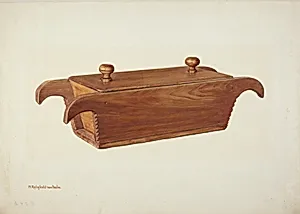
Medium
watercolor, graphite, and colored pencil on paperboard
Dimensions
overall: 33.2 x 45.4 cm (13 1/16 x 17 7/8 in.) Original IAD Object: 28" long; 7 3/8" wide
Classification
Index of American Design
Department
CG-W
Museum
National Gallery of Art, Washington, D.C.
Credit
Index of American Design
Accession Number
1943.8.8085
Rights
Public Domain
Art Historical Context
**Dough Trough a meticulous rendering by artist M. Rosensield-von-Paulin around 1940, captures the humble beauty an everyday American folk object: a wooden dough trough measuring 28 inches long and7⅜ inches wide. Created as part of the Index of American Design (IAD), a Works Progress Administration (WPA project during the Great Depression, this artwork the era's effort to document and celebrate the nation's vernacular crafts. Through watercolor, graphite, and colored pencil on paperboard (33.2 × 45.4 cm), Rosenshield-von-Paulin renders the trough's weathered grain, subtle curves, and practical form with precision, transforming a simple bread-making tool into a testament to American ingenuity and pioneer life. The IAD, active from 1935 to 1942, employed artists across the U.S. to produce over 15,000 such detailed studies of decorative arts, furniture, and utensils, preserving objects that might otherwise fade from memory. This piece, housed in the National Gallery of Art's collection, highlights regional woodworking traditions, likely from rural households where dough troughs were essential for kneading and rising bread. Rosenshield-von-Paulin's mixed-media technique—layering translucent watercolors over graphite sketches—brings out the wood's patina and tactile quality, blending scientific accuracy with artistic sensitivity. Today, *Dough Trough* invites us to appreciate the artistry in utility, reminding visitors of how WPA initiatives not only provided jobs for artists but also fostered national pride in everyday heritage.
About the Artist
M. Rosenshield-von-Paulin · 1855–present
M. Rosenshield-von-Paulin was an American artist active around 1935, best known for their contributions to the Index of American Design, a Federal Art Project initiative under the Works Progress Administration (WPA). During the Great Depression, this New Deal program commissioned artists to create thousands of watercolor renderings documenting American crafts, furniture, and decorative arts, prese...