
Dove
Unknown Artist
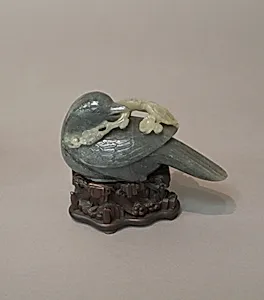
Medium
Nephrite, dark and light gray speckled and veined with black
Dimensions
H. 2 13/16 in. (7.2 cm); W. 5 1/4 in. (13.3 cm); L. 2 3/8 in. (6 cm)
Classification
Jade
Culture & Period
China · Ming dynasty (1368–1644)
Department
Asian Art
Museum
Metropolitan Museum of Art, New York, NY
Credit
Gift of Heber R. Bishop, 1902
Accession Number
02.18.417
Rights
Public Domain
Tags
Art Historical Context
This delicate jade dove, carved from nephrite with its striking dark and light gray speckles veined in black, exemplifies the masterful craftsmanship of China's Ming dynasty (13681644). Measuring just 2 13/16 inches high, 5 1/4 inches wide, 2 3/8 inches long, this sculpture captures the bird in a graceful, naturalistic pose, its wings slightly folded and feathers subtly textured. Nephrite, prized for its toughness and luminous quality, was a favored medium in imperial China, allowing artisans to reveal the stone's natural patterns while achieving fine details through precise carving techniques. During the Ming period, jade carving reached new heights of sophistication, often symbolizing purity, immortality, and moral virtue in Confucian thought. Doves, as gentle creatures, likely evoked themes of peace and harmony, making such pieces ideal for scholarly collections, altars, or elite gifts. Though the artist remains unknown, the work reflects the era's emphasis on organic forms and technical virtuosity, where imperfections in the stone were artfully integrated into the design. Today, this treasure resides in the Metropolitan Museum of Art's Asian Art Department, a 1902 gift from Heber R. Bishop. It invites us to appreciate how Ming jade artists transformed raw stone into timeless emblems of beauty and cultural reverence.