
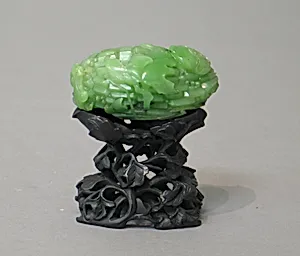
清中期 翡翠苦瓜鎮|Paperweight in the shape of a bitter melon
Unknown Artist
late 18th–early 19th century
Medium
Jade (jadeite)
Dimensions
H. 1 1/8 in. (2.9 cm); H. incl. base 3 1/8 in. (7.9 cm); W. 2 5/8 in. (6.7 cm); D. 1 9/16 in. (4 cm)
Classification
Jade
Culture & Period
China · Qing dynasty (1644–1911)
Department
Asian Art
Museum
Metropolitan Museum of Art, New York, NY
Credit
Gift of Heber R. Bishop, 1902
Accession Number
02.18.655
Rights
Public Domain
Art Historical Context
This exquisite jadeite paperweight, carved in the shape of a bitter melon during China's Qing dynasty (late 18th–early 19th century), exemplifies the era's masterful lapidary arts. Known as *Qing zhongqi feicui kugua zhen*, the translucent green stone captures the vegetable's textured, wrinkled surface with remarkable precision, from the subtle ridges of its skin to the delicate stem and tendrils. Measuring just 1⅛ inches high (excluding its base), this diminutive object showcases the intricate carving techniques honed by Qing artisans, who exploited jadeite's vibrant hues and toughness to create lifelike forms. In imperial China, jade held profound cultural significance as a symbol of purity, immortality, and moral virtue, often adorning scholars' desks as practical yet poetic desk accessories. The bitter melon form likely evoked wishes for health and vitality—its cooling properties in traditional medicine mirrored in artistic motifs for longevity. Produced during the Qianlong (1735–1796) or Jiaqing (1796–1820) reigns, when jade carving reached new heights of technical virtuosity, such pieces blended functionality with auspicious symbolism. A gift to the Metropolitan Museum of Art from Heber R. Bishop in 1902, this rare survivor invites us to appreciate Qing ingenuity: transforming humble stone into a timeless emblem of nature's bounty and human artistry.