
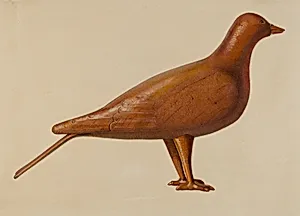
Dove Decoy
1935/1942
Medium
watercolor and graphite on paper
Dimensions
overall: 22.6 x 30.4 cm (8 7/8 x 11 15/16 in.)
Classification
Index of American Design
Department
CG-W
Museum
National Gallery of Art, Washington, D.C.
Credit
Index of American Design
Accession Number
1943.8.16856
Rights
Public Domain
Art Historical Context
Behold the *Dove Decoy*, a watercolor and graphite rendering on paper from the American 20th century created between 1935 and 1942. Measuring a modest 22.6 x 30.4 cm, this delicate work captures the intricate details of a traditional hunting decoy—a wooden carving painted to mimic a mourning dove, luring birds within shotgun range. Such decoys were essential tools in American waterfowling culture, blending functionality with folk artistry. This piece is part of the esteemed Index of American Design, Works Progress Administration (WPA) project launched during the Great Depression. Artists meticulously documented everyday American crafts, from quilts to tools, to celebrate the nation's vernacular heritage and provide jobs for creatives. By rendering folk objects like this decoy in precise watercolor washes and graphite lines, contributors preserved regional traditions that might otherwise fade. Artistically, the medium highlights the decoy's naturalistic feathers, subtle shading, and lifelike posture, showcasing the anonymous maker's skill in evoking motion and allure. Housed in the National Gallery of Art, it invites us to appreciate how humble hunting aids embodied American ingenuity and the wild spirit of the land.
About the Artist
American 20th Century · 1900–1999
"American 20th Century" is the designation used by major institutions such as the National Gallery of Art (NGA) for anonymous and unidentified artists active in the United States during the twentieth century. The artist's personal identity, early life, and training remain undocumented, reflecting the challenges of attribution for unattributed works from this era. No specific teachers, art schools,...