
Dr. Leber
1912
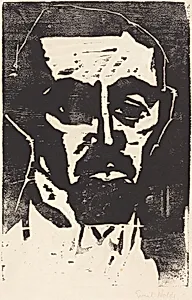
Medium
woodcut [trial proof]
Classification
Department
CG-W
Museum
National Gallery of Art, Washington, D.C.
Credit
Rosenwald Collection
Accession Number
1943.3.6701
Rights
Public Domain
Art Historical Context
Emil Nolde's *Dr. Leber* (1912), a woodcut trial proof, captures the German Expressionist's bold exploration of form and emotion during a pivotal era in modern art. As a key figure in the Die Brücke movement, Nolde rejected naturalistic representation for raw, psychological intensity, often drawing from personal encounters. This print, housed in the National Gallery of Art's Rosenwald Collection, likely portrays a contemporary figure—perhaps a doctor or acquaintance—rendered with stark contrasts and expressive lines that evoke inner turmoil amid Europe's pre-World War I tensions. Woodcuts, Nolde's favored medium here, involve carving into wood blocks and printing relief impressions, allowing for rugged textures and dramatic blacks. As a trial proof, this impression is an experimental state, possibly hand-pulled before the final edition, offering rare insight into the artist's iterative process. Nolde's prints bridged fine art and popular media, democratizing Expressionism's visceral power. Visitors to the NGA's CG-W department will appreciate how *Dr. Leber* exemplifies Nolde's fusion of primitivism and modernity, influencing generations of printmakers with its unflinching directness.
About the Artist
Emil Nolde · 1867–1956
Emil Nolde, born Hans Emil Hansen on August 7, 1867, near the village of Nolde in what was then Prussian Schleswig (now Denmark), grew up on a farm amid devout Protestant Danish and Frisian peasant parents. The youngest of four brothers, he apprenticed as a woodcarver and illustrator in Flensburg from 1884 to 1891, working in furniture factories before studying at the School of Applied Arts in Kar...