
Dr. Louis Vintras
1904
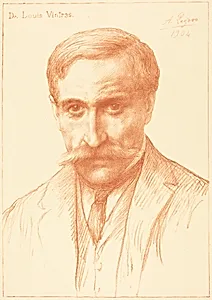
Medium
lithograph in red
Classification
Department
CG-E
Museum
National Gallery of Art, Washington, D.C.
Credit
Rosenwald Collection
Accession Number
1943.3.5418
Rights
Public Domain
Art Historical Context
In the National Gallery of Art's Rosenwald Collection, Alphonse Legros'sDr. Louis Vintras (1904) stands as a striking portrait print that captures the artist's mastery of lithography. Legros, a French-born artist who spent much of his career in, was a key figure in the late 19th- and early 20th-century etching revival, blending Realism with a keen sensitivity to human character. This work depicts Dr. Louis Vintras, rendered with Legros's characteristic psychological depth, inviting viewers to ponder the subject's enigmatic presence. Executed as a lithograph in red ink—a technique that leverages the medium's planar drawing process on stone or metal plates—this print achieves a warm, monochromatic glow. The red hue adds emotional intensity, evoking intimacy and vitality, while lithography's fluid lines allowed Legros to mimic the spontaneity of drawing. Unlike traditional black-and-white prints, this colored variant highlights his innovative approach to tone and texture. Created near the end of Legros's prolific career, *Dr. Louis Vintras* reflects the era's fascination with portraiture as a window into personal and cultural identity. Housed in the Prints department (CG-E), it exemplifies the technical brilliance of fin-de-siècle printmaking, offering visitors a tactile sense of history through its subtle gradients and bold simplicity.
About the Artist
Alphonse Legros · 1837–1911
Alphonse Legros (1837–1911) was born in Dijon, France, and trained in Paris at the drawing school of Horace Lecoq de Boisbaudran, whose unconventional teaching method — which emphasised memory drawing and acute observation over academic convention — would leave a lasting mark on Legros's practice. At Lecoq's school he formed friendships with Jules Dalou and Auguste Rodin that endured throughout hi...