
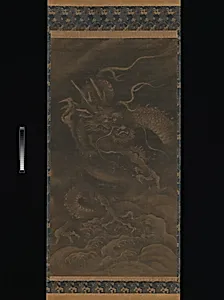
작자미상 용과 호랑이 조선 또는 일본 (에도)|簋簅痡萳 樻虎圖 朝鮮 日本 江戶|Dragon
16th or 17th century
Medium
Hanging scroll; ink on silk
Dimensions
51 1/2 x 27 1/2 in. (130.8 x 69.9 cm)
Classification
Paintings
Culture
Korea or possibly Japan
Department
Asian Art
Museum
Metropolitan Museum of Art, New York, NY
Credit
Rogers Fund, 1912
Accession Number
12.123.2
Rights
Public Domain
Tags
Art Historical Context
This striking hanging scroll, titled *Dragon and Tiger*, depicts powerful mythical creatures rendered in fluid ink washes on silk. Although attributed to the 13th-century Chinese Zen painter Muqi, the work’s style, materials, and 16th- or 17th-century date point to a later East Asian artist working in his revered tradition. Created during the Joseon dynasty in Korea or the Edo period in Japan, the painting reflects the enduring influence of Chinese ink painting across East Asia. Ink on silk was a prestigious medium favored for its luminous surface and ability to capture spontaneous brushwork. The vertical format of the hanging scroll encourages viewers to follow the dragon’s sinuous form from top to bottom, a compositional choice that heightens the sense of movement and energy. Such scrolls were often displayed in temples or scholarly settings, inviting quiet contemplation. Dragons in East Asian art symbolize rain, vitality, and imperial authority. Here the creature’s dynamic pose—likely paired with a tiger—embodies the balance of cosmic forces. Acquired by the Metropolitan Museum in 1912, the scroll offers visitors a vivid glimpse into the cross-cultural artistic exchanges that shaped Korean and Japanese painting during this period.
About the Artist
Muqi · 1250–1280
Muqi Fachang (c. 1210?–1269?), a Chan Buddhist monk from Sichuan, emerged as one of the Southern Song dynasty's most evocative painters, blending spiritual insight with bold ink techniques. Early details of his life remain sparse, but he began as a monk in a Sichuan monastery before becoming a disciple of the revered Chan master Wuzhun Shifan (1177–1249) at Mount Qingcheng, where their master-disc...