
Draped Model, Standing
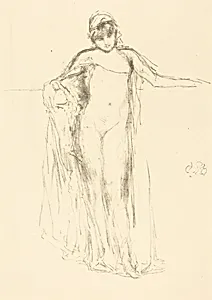
Medium
lithograph in black on laid paper
Dimensions
image: 20.6 × 16 cm (8 1/8 × 6 5/16 in.) sheet: 26.1 × 19.2 cm (10 1/4 × 7 9/16 in.)
Classification
Department
CG-W
Museum
National Gallery of Art, Washington, D.C.
Credit
Rosenwald Collection
Accession Number
1943.3.8803
Rights
Public Domain
Art Historical Context
James McNeill Whistler’s *Draped Model, Standing* (1893) captures the elegant simplicity of a figure study through the artist’s masterful lithography. Printed in black on laid paper—a traditional handmade sheet with visible chain lines that add tactile authenticity—the image measures a modest 20.6 × 16 cm. Whistler, a leading figure in the Aesthetic movement, championed “art for art’s sake prioritizing harmony of tone and form over narrative. This late-career work exemplifies his fascination with subtle gradations and fluid lines, evoking a sense of poised introspection. Lithography allowed Whistler to translate his painterly touch directly onto stone, blending drawing and printing in a spontaneous, expressive technique. By the 1890s, after his celebrated Venice lithographs and Peacock Room controversy, he revisited the human form, using draped models to explore abstraction and rhythm. The stark black ink on paper creates a tonal poetry, reminiscent of his famous nocturnes and portraits like *Whistler’s Mother*. Housed in the National Gallery of Art’s Rosenwald Collection (Department CG-W), this print highlights Whistler’s innovative printmaking legacy. For visitors, it offers a window into 19th-century Aestheticism, where beauty in drapery and shadow invites quiet contemplation of the eternal nude tradition.
About the Artist
James McNeill Whistler · 1834–1903
James Abbott McNeill Whistler (1834-1903) was an American-born painter and printmaker who became a leading figure in the Aesthetic Movement and pioneer of Tonalism and Japonisme. He revolutionized art by championing "art for art's sake" and treating paintings as visual equivalents of musical compositions, titling works as "arrangements," "harmonies," and "nocturnes" to emphasize formal qualities o...