
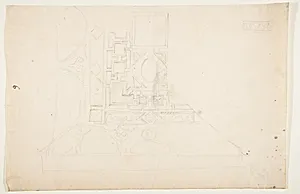
Drawing After and Architectural Fragment of a Coffered Ceiling
19th century
Medium
Graphite on laid paper
Dimensions
sheet: 12 x 8 in. (30.5 x 20.3 cm)
Classification
Drawings
Department
Drawings and Prints
Museum
Metropolitan Museum of Art, New York, NY
Credit
Gift of Mrs. Regina Slatkin, 1963
Accession Number
63.712.56
Rights
Public Domain
Art Historical Context
This delicate 19th-century drawing created by an anonymous French artist captures the intricate details of an architectural fragment a coffered ceiling—a of classical design featuring recessed, often ornamented panels that add depth and grandeur to interiors. Such motifs, rooted in ancient Roman and Renaissance architecture, were avidly studied in 19th-century France amid a revival of historicism and neoclassicism. Architects, students, and artists frequently made "drawings after" originals to document and preserve these elements, blending education with admiration for the past. Rendered in graphite on laid paper—a textured, handmade sheet typical of the era that provided an ideal surface for fine lines and subtle shading—the work showcases precise draftsmanship. The modest 12 x 8-inch sheet allowed for portable sketching, likely during visits to historic sites or museums. Graphite's versatility enabled the artist to convey the ceiling's geometric patterns and subtle reliefs with remarkable fidelity. Housed in the Metropolitan Museum of Art's Drawings and Prints department, this piece, generously gifted by Mrs. Regina Slatkin in 1963, exemplifies the unsung role of anonymous sketches in art history. It invites visitors to appreciate how everyday study drawings bridged antiquity and modernity, fueling France's enduring architectural legacy.
About the Artist
Anonymous, French, 19th century · 1800–1900
**Anonymous, French, 19th Century (ca. 1800–1900)** The artist cataloged as Anonymous, French, 19th century embodies the enigmatic yet essential contributions of unidentified creators to France's vibrant 19th-century art world. Active roughly between 1800 and 1900, this figure—or potentially collective workshop—produced a diverse array of works amid the nation's transition from Neoclassicism thro...