
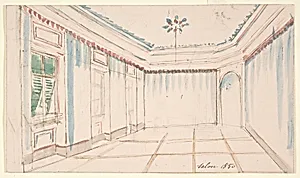
Drawing of an Interior: Salon
Medium
Graphite, pen and brown ink, watercolor. Framing lines in graphite.
Dimensions
sheet: 4 3/4 x 8 1/8 in. (12 x 20.7 cm)
Classification
Drawings
Department
Drawings and Prints
Museum
Metropolitan Museum of Art, New York, NY
Credit
Purchase, Anne and Carl Stern Gift, 1972
Accession Number
1972.642.12
Rights
Public Domain
Tags
Art Historical Context
This delicate drawing captures the elegance of a mid-19th-century French salon, rendered with graphite, pen and brown ink, and subtle watercolor washes. Created in 1850 by an anonymous French artist, the small sheet (just under five by eight inches) offers an intimate glimpse into the domestic spaces of the period. The careful framing lines and mixed media suggest a study intended to record both architectural details and the play of light across furnishings, fabrics, and decorative objects typical of bourgeois interiors. In 19th-century France, the salon served as the heart of social and intellectual life, where guests gathered for conversation, music, and cultural exchange. This drawing reflects that world through its precise yet atmospheric rendering of upholstered seating, patterned carpets, and ornate wall treatments. Such works were often produced as records for architects, upholsterers, or collectors, preserving the taste and material culture of the July Monarchy and early Second Empire eras. Housed in the Metropolitan Museum’s Department of Drawings and Prints, the piece exemplifies how anonymous draftsmen contributed to our understanding of everyday design history. Its modest scale and technical refinement invite viewers to appreciate the quiet artistry behind documenting the private spaces that shaped public life.
About the Artist
Anonymous, French, 19th century · 1800–1900
**Anonymous, French, 19th Century (ca. 1800–1900)** The artist cataloged as Anonymous, French, 19th century embodies the enigmatic yet essential contributions of unidentified creators to France's vibrant 19th-century art world. Active roughly between 1800 and 1900, this figure—or potentially collective workshop—produced a diverse array of works amid the nation's transition from Neoclassicism thro...