
Dress
Unknown Artist
1800–1804
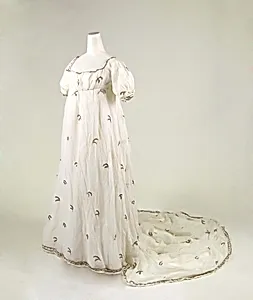
Medium
cotton, silver
Classification
Dress
Culture
probably French
Department
Costume Institute
Museum
Metropolitan Museum of Art, New York, NY
Credit
Polaire Weissman Fund, 2015
Accession Number
2015.538
Rights
Public Domain
Art Historical Context
This exquisite dress, crafted between 1800 and 1804 by an unknown artist, likely hails from France, the epicenter of early 19th-century fashion Made from cotton adorned with shimmering silver elements—possibly metallic threads or embroidery—it exemplifies the Empire style that dominated the Napoleonic era. High-waisted and flowing, such gowns drew inspiration from ancient Greek and Roman drapery, reflecting the neoclassical revival following the French Revolution. Cotton's lightweight breathability made it ideal for summer wear, while the silver accents added a touch of opulent sparkle, signaling the wearer's status in a time of social transformation. The dress's materials highlight innovative textile techniques of the period. Cotton, increasingly accessible through early industrialization and trade from the American South and India, allowed for delicate, machine-printed patterns. The silver integration, a luxurious detail, would have caught the light during evening promenades or balls, blending practicality with extravagance. Now housed in the Metropolitan Museum of Art's Costume Institute, thanks to the Polaire Weissman Fund acquisition in 2015, this garment offers a tangible glimpse into Regency-era femininity and fashion's role as cultural expression. Visitors can appreciate how it captures a pivotal moment when women's silhouettes shifted toward simplicity and grace, influencing global styles for decades.