
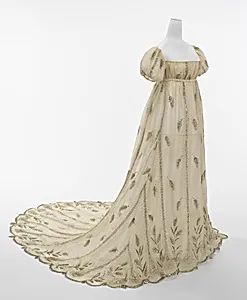
Evening dress
Unknown Artist
1805–10
Medium
cotton, metallic thread
Classification
Evening dress
Culture
French
Department
Costume Institute
Museum
Metropolitan Museum of Art, New York, NY
Credit
Museum Accession
Accession Number
C.I.X.646
Rights
Public Domain
Art Historical Context
This elegant evening dress, in France between 1805 and 1810, embodies the neoclassical Empire style that defined early 19th-century fashion. During Napoleon Bonaparte's reign, women's attire drew inspiration from ancient Greek and garments, featuring high-waisted silhouettes, slender columns of fabric, and minimal ornamentation to evoke classical ideals of grace and simplicity. Worn for soirées and balls, such dresses symbolized the refined social life of the French elite amid post-Revolutionary elegance. Made from lightweight cotton—a practical yet luxurious choice for the era—the gown is enriched with metallic threads, likely woven or embroidered for a subtle shimmer under candlelight. This technique added opulence without overwhelming the clean lines, highlighting the period's innovative blend of everyday materials with precious embellishments. Cotton's breathability suited the layered undergarments of the time, while metallic accents nodded to imperial grandeur. Housed in the Metropolitan Museum of Art's Costume Institute, this anonymous masterpiece offers a glimpse into French cultural dominance in fashion, influencing wardrobes across Europe and America. It reminds us how clothing served as both personal expression and political statement in a transformative age.